Why do transformation programmes keep struggling even after organisations adopt modern delivery methods?
The problem may not be the methodology.
It may be everything surrounding it.
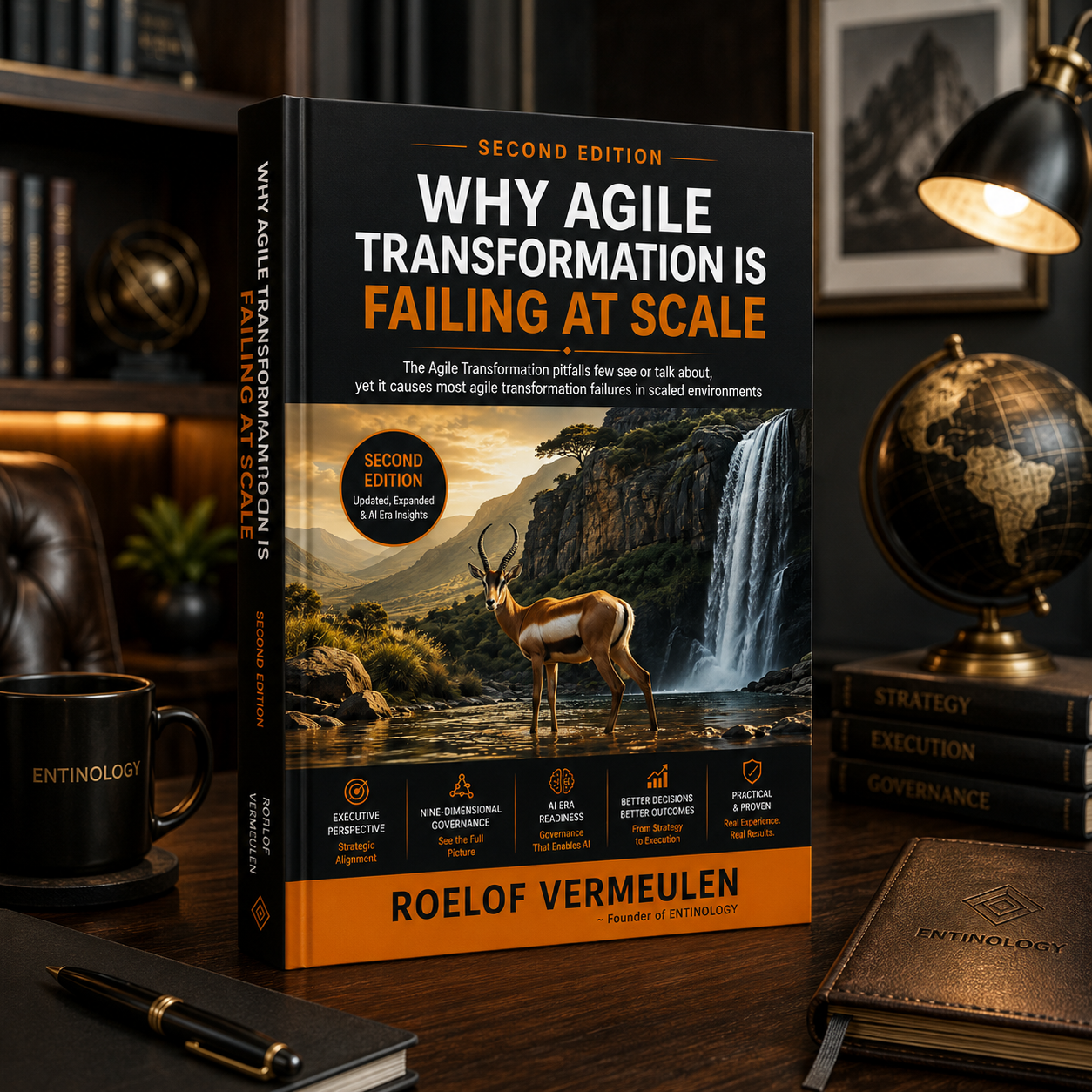
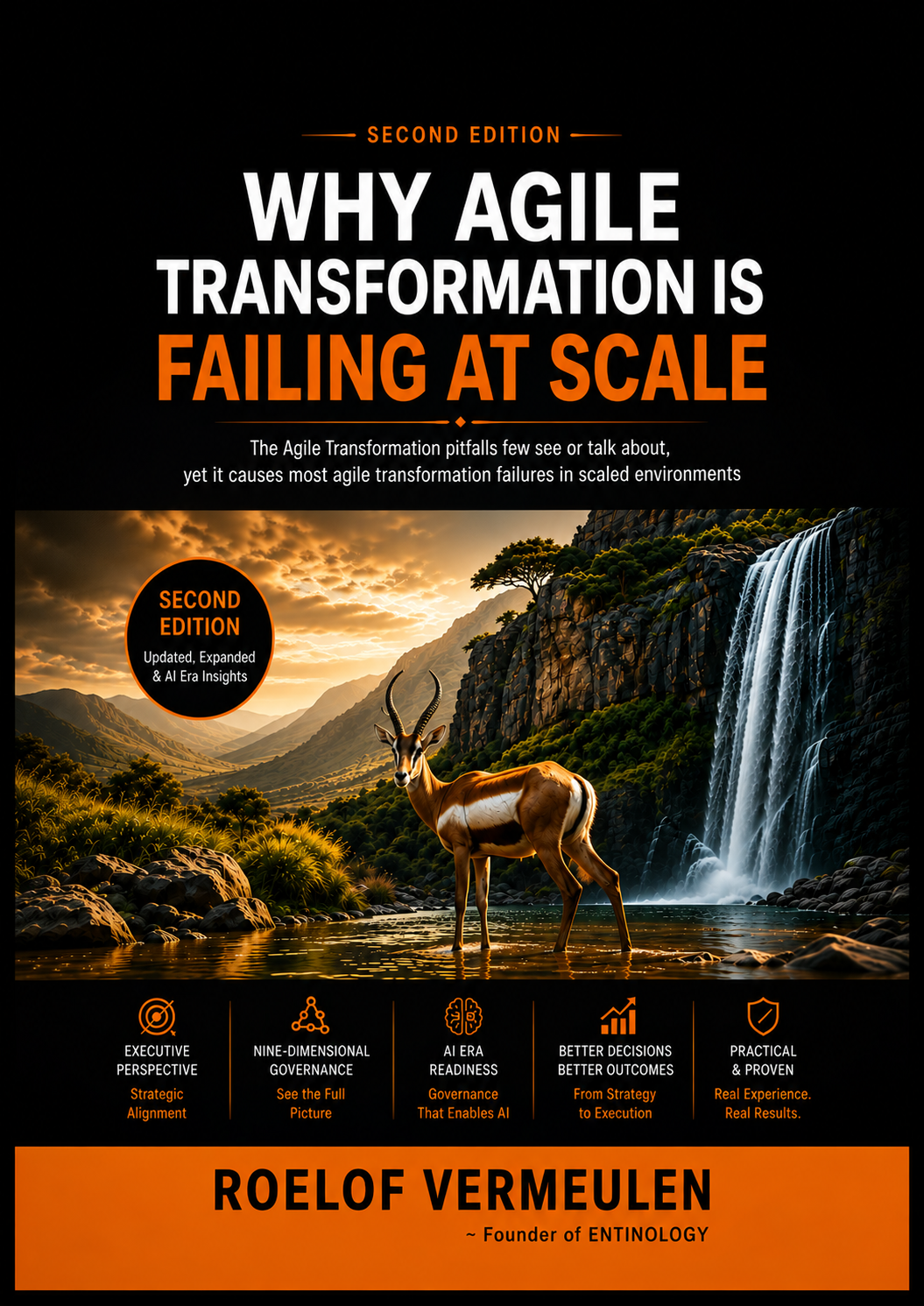
Why Agile Transformation Is Failing at Scale: Second Edition challenges the assumption that adopting Agile practices automatically creates an Agile organisation.
Drawing on nearly three decades of experience across banking, telecommunications, insurance, retail, hospitality and higher education, Roelof Vermeulen examines what happens when modern delivery practices meet the realities of large organisations.
Teams may work in sprints. Boards may be filled with cards. New roles may be introduced. Training may be completed.
Yet governance, decision-making, budgeting, accountability and organisational behaviour can remain fundamentally unchanged.
The result is an organisation that looks transformed at the execution layer while continuing to operate according to its previous management system.
What this book explores
The book moves beyond a simple Agile-versus-traditional debate and asks a more useful question:
What does this particular project actually require, and does the chosen approach govern everything necessary to deliver it successfully?
Readers will explore:
- Why large-scale transformation is fundamentally different from changing how individual teams work
- How organisational culture and executive behaviour influence transformation outcomes
- Why methodology alone cannot solve governance and accountability problems
- The strengths and limitations of different project delivery approaches
- Why time, scope and cost still matter
- The limitations of relative estimation when executives need real commitments
- Why project scope extends far beyond software and technology
- How data quality has become critical to successful AI adoption
- Why AI implementation should be connected to specific organisational roles and accountabilities
- How governance needs to evolve when AI becomes part of project delivery
- Why continuous improvement must become an operating discipline rather than an occasional ceremony
Introducing the Entinology Diamond
A central idea in the book is that complex projects cannot be understood through the software dimension alone.
The Entinology Diamond examines project delivery across nine dimensions:
Process, Regulatory, Customer, Channel, Data, Software, Technology, Organisation and Location.
This broader perspective helps expose areas of project scope that may otherwise remain invisible until they become delivery problems.
Introducing EPM-AI
The book also introduces EPM-AI, Entrepreneurial Project Management with Artificial Intelligence.
Rather than simply replacing one methodology with another, EPM-AI is presented as an overarching governance approach connecting:
Executive Strategy → Quarterly Objectives → Sprint Targets → Operational Delivery
It combines this planning hierarchy with real accountability, multidimensional project governance, continuous improvement, trustworthy data and role-based AI adoption.
The objective is not to make organisations loyal to a methodology.
The objective is successful delivery.
Who should read this book?
This book is particularly relevant to:
Executives and senior leaders responsible for transformation, technology investment and organisational performance.
CIOs, CTOs and transformation leaders trying to understand why enterprise transformation remains difficult despite substantial investment.
Project and programme managers who need to reconcile delivery flexibility with real commitments around time, scope, cost and risk.
Agile practitioners and delivery leaders who want to examine both the genuine strengths and structural limitations of the environments in which they work.
PMO and governance professionals looking for a broader approach to enterprise delivery governance.
AI transformation leaders considering how artificial intelligence should be integrated into project delivery without removing human accountability.
This is not an anti-Agile book
The book does not argue that Agile practices have no value.
It argues that no methodology should be expected to govern problems it was never designed to govern.
Scrum, Kanban, XP, TDD, traditional project management, PRINCE2, SAFe, CPMAI and emerging AI-native approaches are examined according to what they do well, what they govern and where their boundaries lie.
The conclusion is deliberately practical:
Choose delivery practices according to the problem. Govern the whole project. Keep accountability visible. Build trustworthy data. Integrate AI where it creates measurable value.